This glossary is about the most important and basic concepts about Architecture.
Each definition has the term, part of speech, pronunciation, translation, an example and an image.
Air-entrained concrete
Noun
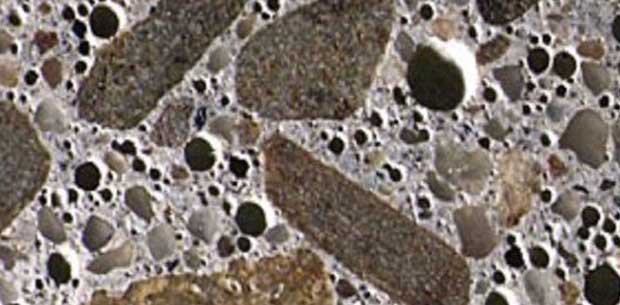
A low-density type of concrete throughout which small air bubbles are dispersed in order to increase its frost resistance: used for making roads.
Example: Air-entrained concrete contains billions of microscopic air cells per cubic foot.
es: Concreto con aire incorporado
Architectural concrete
Noun
Architectural concrete is concrete that will be permanently exposed to view and therefore requires special care in selection of the concrete materials, forming, placing, and finishing obtaining the desired architectural appearance.
Example: The facade is in addition to this strikingly sleek design mainly characterized by the use of white architectural concrete.
es: Hormigón arquitectónico
Asphalt concrete
Noun
Asphalt Concrete is a composite material commonly used in construction of roads, highways, airports, parking lots, and many other types of pavement.
Example: It is made clear that in construction cost calculation per kilometer, construction cost of the asphalt concrete, granular base, granular sub base and soil-cement were considered.
es: Concreto asfaltico
Axis
noun
A real or imaginary straight line going through the centre of an object that is spinning, or a line that divides a symmetrical shape into two equal halves
Example: The city street is an axis that is reinforced by the buildings on both sides.
es: Eje
Backup wall
Noun
Common interior walls (backup walls) are cold-formed steel framed walls with water-resistant sheathing and concrete masonry
Example: Backup walls are a virtually unbeatable solution for all building types in all climates.
es: Muro de respaldo
Brick courses
Noun
A course is a layer of the same unit running horizontally in a wall. It can also be defined as a continuous row of any masonry unit such as bricks, concrete masonry units (CMU), stone, shingles, tiles, etc.
Example: In header bond brick masonry all bricks are constructed in the header course.
es: Hilada de ladrillos
Cellular concrete
Noun
Cellular concrete is a lightweight cement-based material, containing many gas bubbles evenly distributed in the volume, produced by blending and maturing of a mixture of cement, filler, water, agent generating cells.
Example: Moreover, our cellular concrete provides excellent insulation, reducing the risk of fire.
es: Hormigón celular
Colored concrete
Noun
Colored concrete, also known as decorative concrete, allows traditional grey concrete to be stained and dyed different colors
Example: Awarded for the museum: colored concrete gives the perfect look.
es: Hormigón con color
Concrete block
Noun
A concrete block is primarily used as a building material in the construction of walls. It is sometimes called a concrete masonry unit (CMU). A concrete block is one of several precast concrete products used in construction.
Example: Just four cement, concrete block walls.
es: Bloque de concreto
Cured concrete
Noun
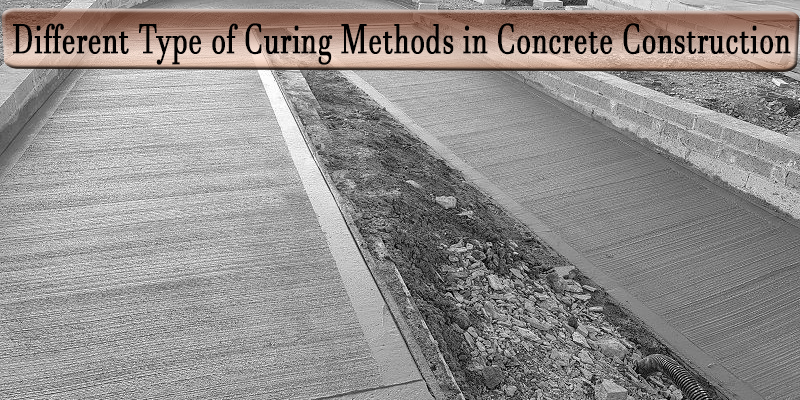
Cured concrete means that the concrete has reached its design strength (the strength that the structural engineer intended). This depends on type of concrete mix and other variables.
Example: Cement areas, mortars or fully cured concrete
es: Hormigón curado
Dovetail insert
Noun
A joint made by inserting tenons on one piece into mortise holes in the other.
es: Inserto de cola de milano
Edge
Noun, verb
The outside limit of an object, area, or surface; a place or part farthest away from the center of something.
Example: "An example of edge is the area right before a cliff begins"
es: Borde
Exposed concrete
Noun
Exposed concrete refers to concrete whose surface is a visible part of the architectural and interior design of the building.
Example: The monument consists of an exposed concrete slab symbolizing the expansion of construction.
es: Concreto expuesto
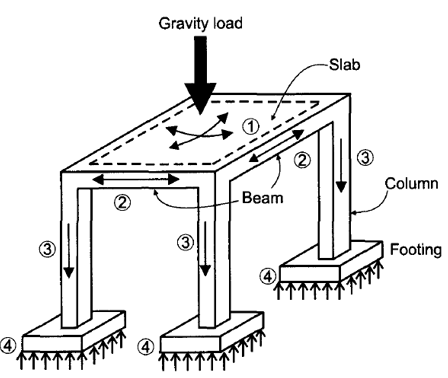
Gravity load
Noun
Gravity loads are body loads available only in Structure. These loads simulate the force of gravity as it affects your model.
Example: Gravity loads are the vertical forces that act on a structure.
es: Carga gravitacional
Green concrete
Noun
Green concrete refers to fresh concrete that is uncured or isn't strong yet.
Green concrete can also mean concrete that is made from recycled stone or has other eco-friendly materials or properties.
Example: Diamond tools for asphalt, green concrete and abrasive materials
es: Hormigón fresco
Grid
Noun
A pattern or structure made from horizontal and vertical lines crossing each other to form squares:
Example: In Barcelona the streets are laid out in/on a grid system.
es: Trama
Hanging off
Verb
To fasten or attach (a thing) so that it is supported only from above or at a point near its own top; To be suspended from something
Example: The ornaments hang off the chandelier.
es: Colgando de
Horizontal mortar joints
Noun
In masonry, mortar joints are the spaces between bricks, concrete blocks, or glass blocks, that are filled with mortar or grout.
Example: Concave Mortar Joint
es: Juntas de mortero horizontales
Insulating concrete
Noun
Insulating concrete forms, or ICFs, are forms used to hold fresh concrete that remain in place permanently to provide insulation for the structure they enclose.
Example: The blocks are perforated and filled with insulating concrete.
es: Hormigón aislante
Ladder-type systems
Noun
A ladder is a vertical or inclined set of rungs or steps. There are two types: rigid ladders that are self-supporting or that may be leaned against a vertical surface such as a wall, and rollable ladders, such as those made of rope or aluminium, that may be hung from the top.
Example: Ladder-type systems are the frame, usually portable, of wood, metal, or rope, used for ascent and descent,
es: Sistemas de tipos de escalera
Landmark
noun
An object or feature of a landscape or town that is easily seen and recognized from a distance, especially one that enables someone to establish their location.
Example: The Golden Gate Bridge is a famous landmark in San Francisco.
es: Hito
Laterally
Adverb
At, toward, or from the side or sides; sideways.T
Example: He tried to move laterally , away to his right, but the gnarled branches of a now-dead bush blocked his path.
es: Lateralmente
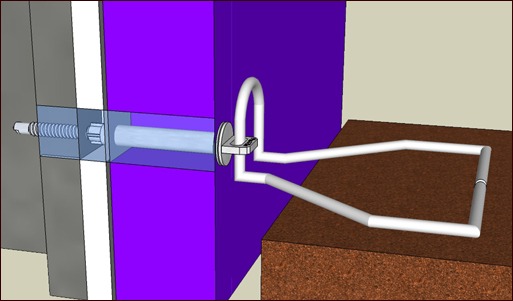
Masonry ties
Noun
Wall ties, sometimes called ‘brick ties’, are used in buildings with cavity walls. They are used to join the two leaves of a cavity wall together, allowing the two parts to act as a homogeneous unit
Example: To prevent the brick veneer from falling off the building, we use masonry ties.
es: Lazos de albañilería
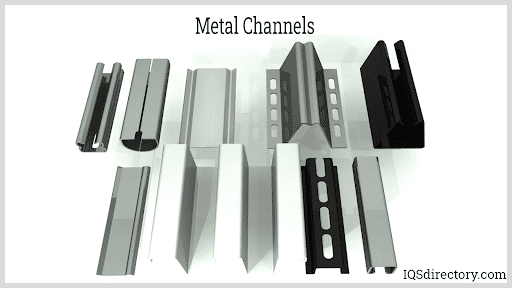
Metal channel
Noun
A metal channel is a roll formed metal strip that has been shaped into a tube or a U, J, or C shape for industrial and manufacturing use.
Example: C channels are one of the more common types of metal channels and are widely used in construction as building, wall, roof, and ceiling supports.
es: Canal metálico
Metal decking
Noun
Metal decking is corrugated metal sheeting that's used as a structural roof deck or composite floor deck.
Example: Cellular Deck
Has plate shop welded to underside of deck. Also known as "electrical" deck.
es: Cubierta metálica
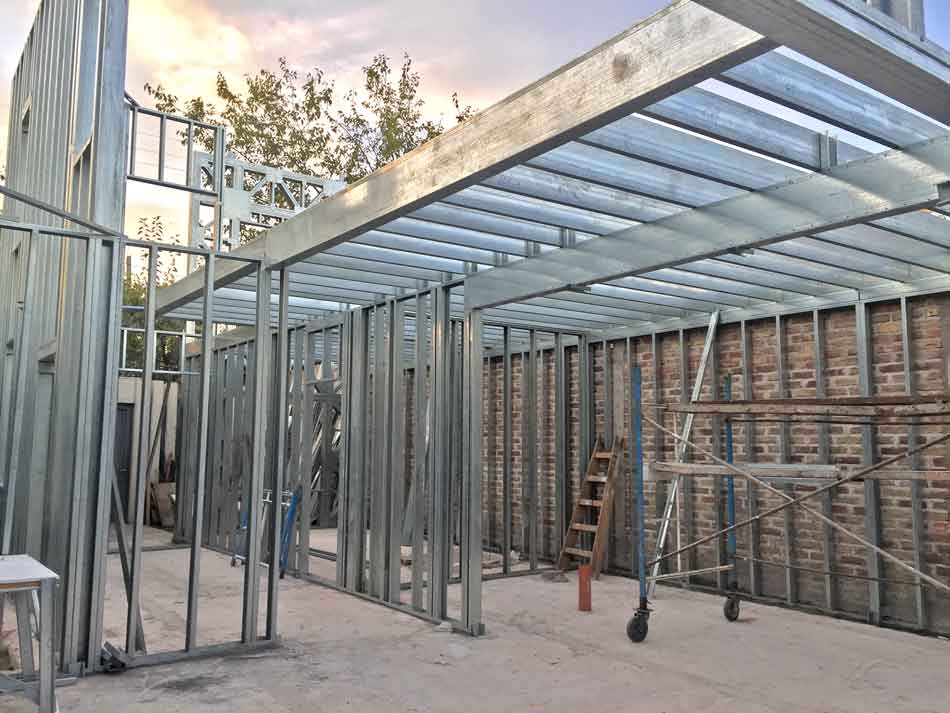
Metal framing
Noun
The construction of walls and planes using cold-formed steel components.
Example: The development of this technique (metal framing) made the construction of the skyscraper possible.
es: Estructura metálica
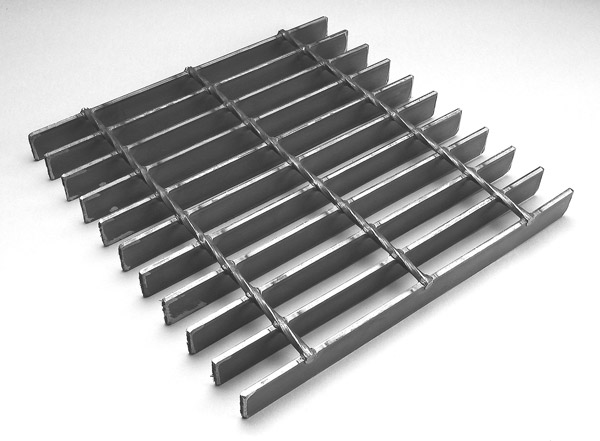
Metal grating
Noun
An open grid assembly of metal bars, in which the bearing bars, running in one direction, are spaced by rigid attachment to cross bars running perpendicular to them or by bent connecting bars extending between them.
Example: Metal grating can be structural or non-structural.
es: Rejilla de metal
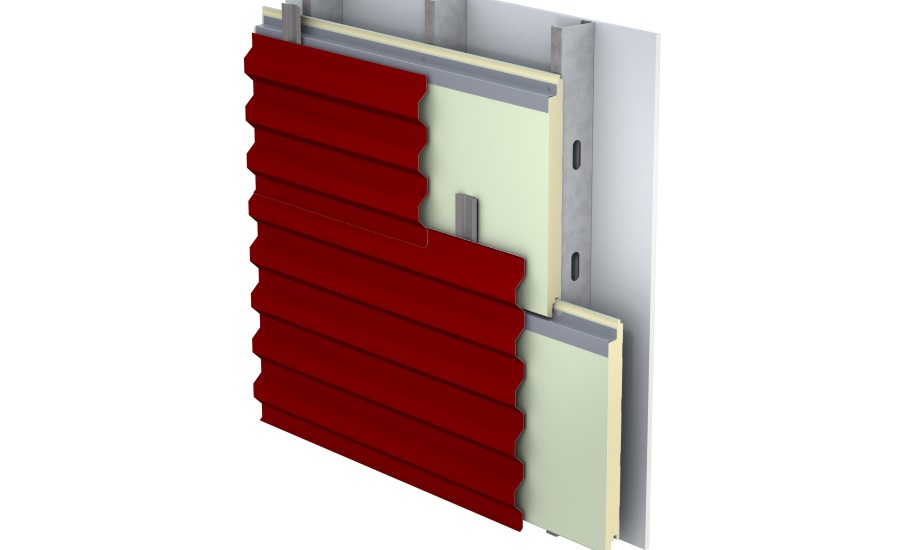
Metal panel
Noun
Architectural metal panels are a type of exterior siding
Example: Metal panel is a general term describing any flat, thin sheet of metal. It can be any type of metal (stainless steel, aluminum, titanium, etc)
es: Panel de metal
Metal rod
Noun
Metal rods are specially formed pieces of metal and alloy that are shaped into a rod-like aesthetic hence the name.
Example: Metal rods have the pattern of round bars or rod, rectangular or flat bars, square bars, hexagons, and other patterns of bar stock.
es: Varilla metálica
Metal roofing
Noun
A metal roof is a roofing system made from metal pieces or tiles characterized by its high resistance, impermeability and longevity.
Example: Five of the most common materials used in metal roofing are aluminum, zinc, copper, and stainless steel.
es: Tejados metálicos
Metal stud
Noun
A structural steel member used for framing walls just as a regular wooden one.
Example: Metal studs are healthier than wood studs because metal does not emit VOCs.
es: Perno metálico
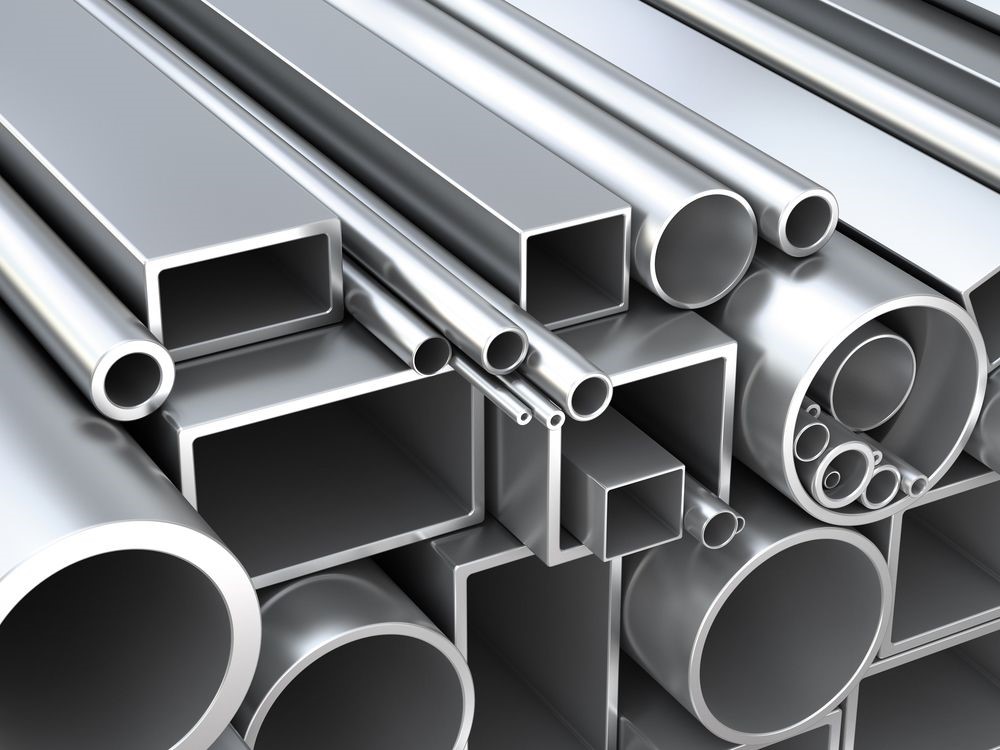
Metal tubing
Noun
Metal tube (tubing) is made of metallic elements or alloys and is designed for specific industrial applications. Tubing is any shape that's hollow (open in the middle).
Example: Compared to other types of tubing, metal tube is stronger and most robust, making it better suited for structural applications and high-pressure fluid flow.
es: Tubo metálico
Multi-story
Adjective
A multi-storey building has several floors at different levels above the ground.
Example: The Moskovski Department Store, a vast multistory complex near the city's center.
es: De varios pisos
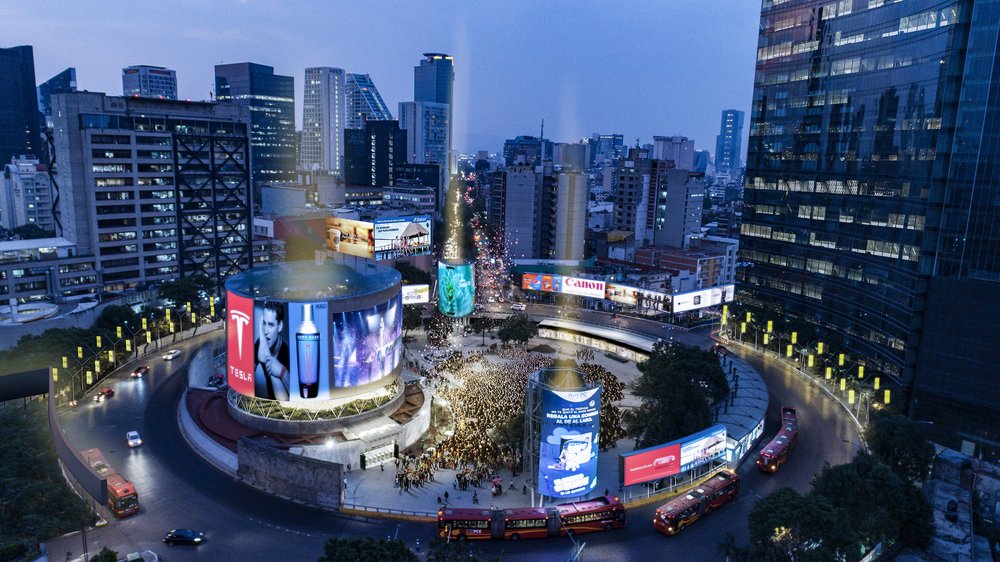
Node
noun
A node is a point of connection. Technically, a traffic intersection is a node since multiple roads connect at that point.
Example: "The intersections of two or more such arteries would clearly become major nodes of traffic and urban activity"
es: Nodo
Porous concrete
Noun
Pervious concrete is a special type of concrete with a high porosity, made from a mixture of cement, water, coarse aggregate and a minimal amount of fine aggregate (sand).
Example: The basic support platform is formed by a layer of porous concrete and two layers of special asphalt.
es: Hormigón poroso
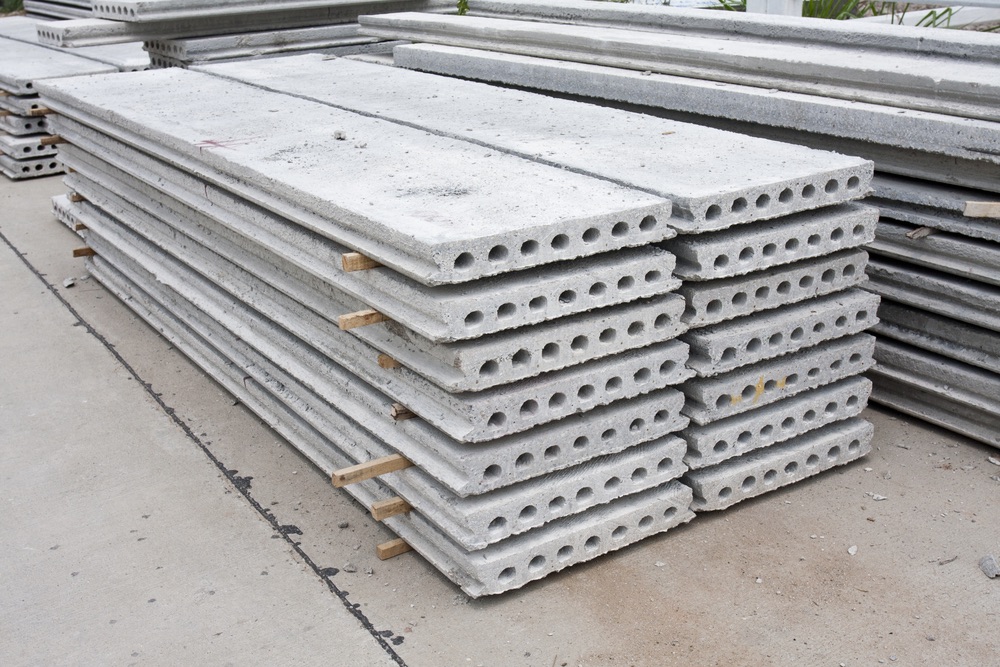
Precast concrete
Noun
Precast concrete is a form of concrete that is prepared, cast and cured off-site, usually in a controlled factory environment, using reusable molds.
Example: Windows are framed by bright precast concrete elements.
es: Concreto prefabricado
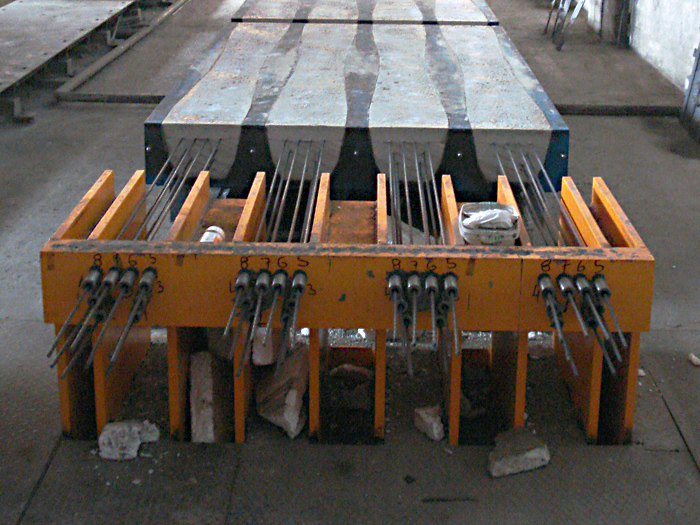
Prestressed concrete
Noun
Prestressed concrete is a form of concrete used in construction. It is substantially "prestressed" (compressed) during production, in a manner that strengthens it against tensile forces which will exist when in service.
Example: Prestressed concrete is used particularly for bridges, but also in building especially designed structures.
es: Hormigón pretensado
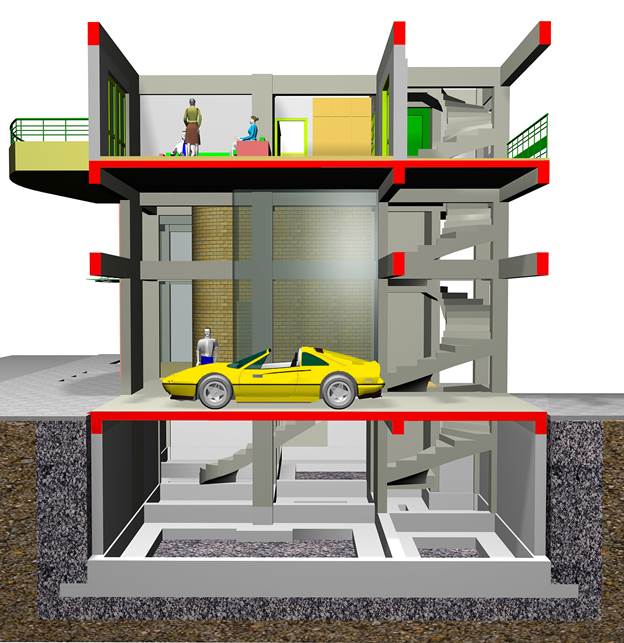
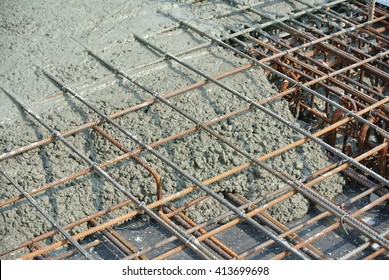
Reinforced concrete
Noun
Concrete in which metal (such as steel) is embedded so that the two materials act together in resisting forces.
Example: A row of reinforced concrete pillars supports the bridge.
es: Concreto reforzado
Relief angle
Noun
The relief angle is the angle between a cutting tool and the workpiece it has just cut.
A structural steel member that relieves the weight of another system constructed within the building.
Example: Small relief angles are necessary to give strength to the cutting edge when machining hard and strong materials
es: Ángulo de alivio
Routes and circulation
Noun
Circulation routes are the pathways people take through and around buildings or urban places. Circulation is often thought of as the 'space between the spaces', having a connective function.
Example: The general route and circulation of the museum is through a grand staircase on the facade
es: Trayectos y circulación
Steel angle
Noun
Steel angles are the most basic type of roll-formed steel. They are formed by bending a single angle in a piece of steel. Angle Steel is 'L' shaped; the most common type of Steel Angles are at a 90 degree angle. The legs of the “L” can be equal or unequal in length.
Example: Steel angles are hot rolled, and are most often structural.
es: Ángulo de acero
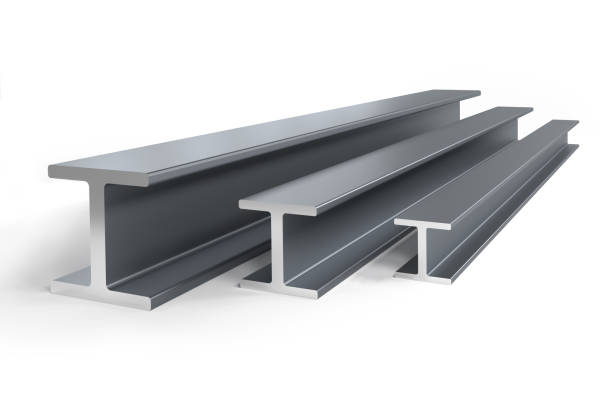
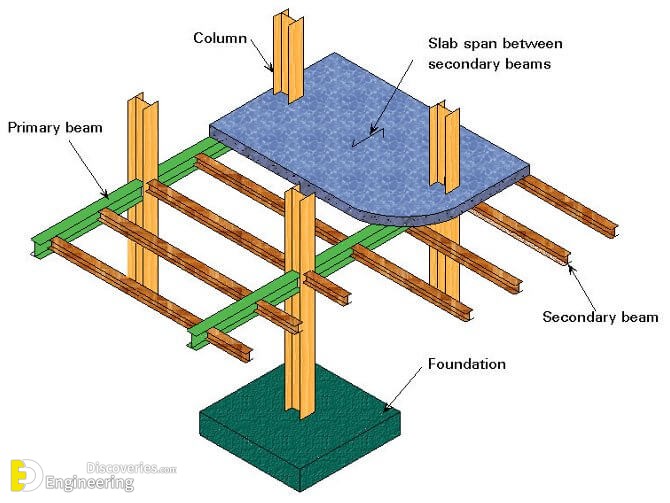
Steel beam
Noun
A steel beam is a structural steel product that is made to support heavy loads.The specifications of a structure determine the geometry, size and shape of beams.
Example: I beam is a shape of structural steel used in buildings, and it is also known as H, W, wide, universal beam, or rolled joist.
es: Viga de acero
Steel column
Noun
A steel column is a vertical structure member used in construction to provide essential support. They may carry loads in compression or they may transfer loads.
Example: Steel columns are hot rolled, vertical steel structural framing members.
es: Columna de acero
Steel framing
Noun
Steel frame is a building technique with a "skeleton frame" of vertical steel columns and horizontal I-beams.
Example: Steel framing is a general term. It could be structural or non-structural shapes.
es: Armazón de acero
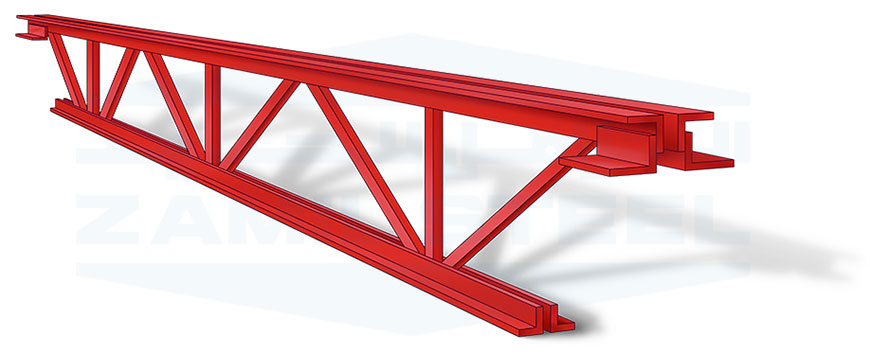
Steel joist
Noun
Steel joists are open web lightweight steel trusses consisting of parallel chords and a triangulated web system, proportioned to span between bearing points.
Example: A rolled steel joist (RSJ) is a common type of beam used for a structural steelwork. It is also known as an 'I-beam'.
es: Viguetas de acero
Steel member
Noun
Member is a general term. Steel members are any part of a primary structural system. Beams, columns, girts, joists, etc.
Example: Structural steel is a category of steel used for making construction materials in a variety of shapes. Beams, columns, girts, joists, etc.
es: Miembro de acero
Steel plate
Noun
Steel Plate, or structural steel is simply steel sheet material that can be customarily cut and welded to develop a more elaborate product.
Example: Steel Plate Systems are focused strongly on project details.
es: Chapa de acero
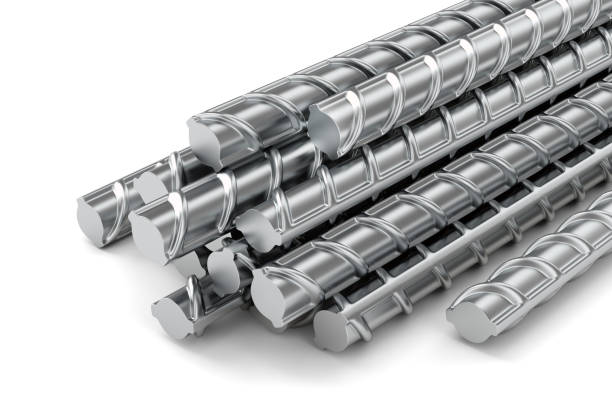
Steel reinforcement
Noun
Steel reinforcement are steel bars that are provided in combination with plain cement concrete to make it reinforced concrete.
Example: Rebar is used in concrete to provide additional strength, as concrete is weak in tension, while steel is strong in both tension and compression.
es: Refuerzo de acero
Steel reinforcing
Noun
Commonly called "rebar". It is used in bridges, buildings, skyscrapers, homes, warehouses, and foundations to increase the strength of a concrete structure.
Example: Rebar is used in concrete to provide additional strength, as concrete is weak in tension, while steel is strong in both tension and compression.
es: Refuerzo de acero
Steel rod
Noun
A thin straight metal bar
Example: The steel rods inside the structure of a building that helps make it sturdy.
es: Varilla de acero
Steel sections
Noun
Steel sections describe the profile or shape of a structural steel member. Engineers use the section properties for their calculations.
Example: Designers, architects and engineers choose different sections for their aesthetics and structural qualities – their choices determined by size, weight, and profile. Steel is extremely versatile and can be molded to many shapes.
es: Perfiles de acero
Supports
Noun
Something that holds weight of something
A thing that bears the weight of something or keeps it upright.
Example: A fixed support is the most rigid type of connection. It constrains the member in all translations and rotations (I.e. it cannot move or rotate in any direction).
es: Apoyos
Tie (something) back to
Verb
To draw and restrain something back and out of the way.
Example: George tied the curtains back to let a little more light in.
es: Atar (algo) a
Transfers
Transitive verb
To move (someone or something) from one place to another
Example: An 8 m 2 solar collector absorbs solar radiation and TRANSFERS heat to the collector fluid, a water-glycol mix.
es: Transferencias
Unreinforced concrete
Noun
Concrete without reinforcement or reinforced only for shrinkage or temperature changes.
Example: The buttresses were made of masonry and the vaults of unreinforced concrete, covered with various layers of masonry, dry stone, earth, etc.
es: Hormigón no reforzado
Urban legibility
Noun
The most important concept in spatial perception, which means that urban spaces should be easily identified and that can be interrelated in mind.
Example: "Urban legibility should help citizens find themselves in spaces and feel safe and secure in them"
es: Legibilidad urbana
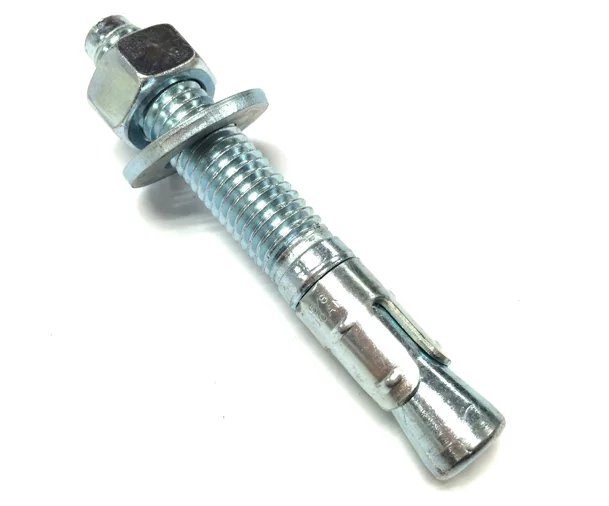
Wedge anchor
Noun
"Wedge anchor" is a generic term for a type of anchor used to fasten a variety of materials to concrete.
Example: Wedge anchors can be used in numerous applications as long as the base material is solid concrete.

























:format(webp):no_upscale()/cdn.vox-cdn.com/uploads/chorus_asset/file/9183243/Amrita_Marino_Curbed_ATL_FINAL.jpg)